Here is a fact that is hard to shake: the rain that falls anywhere on Earth — including over Antarctica and the remote Tibetan Plateau — now carries levels of "forever chemicals" that exceed U.S. safety guidelines for drinking water. That was the conclusion of a 2022 study in the journal Environmental Science & Technology, whose authors argued these chemicals have crossed a "planetary boundary": there is no longer a clean place on the planet to escape them.
You have probably seen the phrase in headlines many times since — PFAS in drinking water, in the blood of nearly every American tested, even in a 2023 study that detected them in some menstrual products at thousands of parts per million. And in 2026, the label finally started carrying real legal weight for one of the industries that puts these chemicals closest to your skin every single day: clothing.
On August 18, 2026, the U.S. Court of Appeals for the D.C. Circuit upheld the Environmental Protection Agency's decision to designate two of the most common forever chemicals as hazardous substances, rejecting a challenge brought by seven business groups including the U.S. Chamber of Commerce. At the same time, a wave of state laws that took effect on January 1, 2026 now bans these chemicals from ordinary apparel in Maine, Vermont, California, and others. Lawyers are already describing a surge in demand letters aimed at clothing and textile brands.
If that all sounds abstract, here is the plain-language version: the stuff that makes a jacket shrug off rain and a shirt resist stains has, for years, often been PFAS — the same chemicals now falling in the rain worldwide — and the rules governing it just changed underneath the entire apparel industry. Here's what's actually going on.
What are PFAS, and why are they in clothing?
PFAS stands for per- and polyfluoroalkyl substances — a family of thousands of synthetic chemicals built around extremely strong carbon–fluorine bonds. That bond is the whole point: it makes PFAS superb at repelling water, oil, and grease, and it makes them extraordinarily durable. It is also why they earned the nickname "forever chemicals" — they break down so slowly that they accumulate in soil, water, and human blood over time.
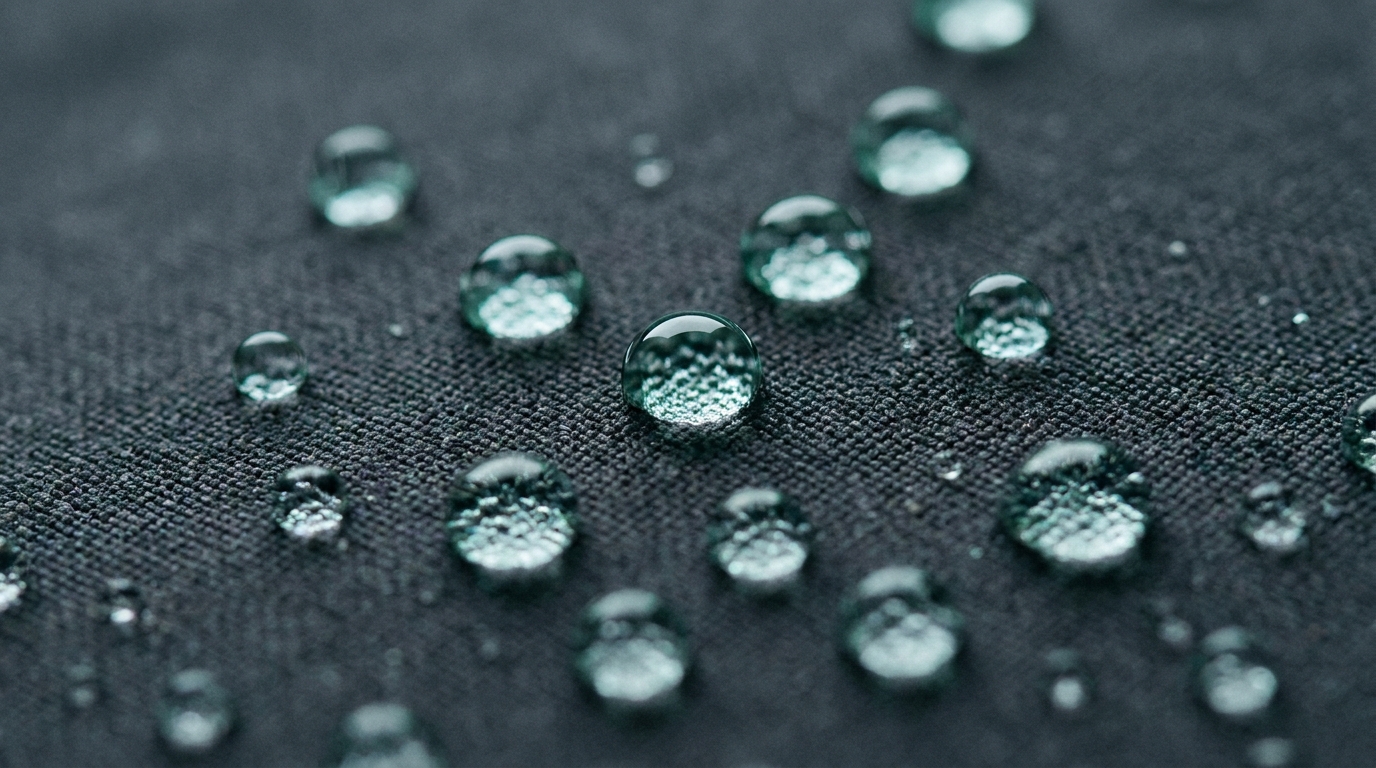
In textiles, PFAS have been the default tool for durable water- and stain-repellency: rain jackets, hiking gear, school uniforms marketed as stain-resistant, tablecloths, and upholstery. The performance is real. The trade-off is permanence.
There is no longer a clean place on the planet to escape them.
Why the health and environmental concern?
The scientific concern is well-documented at the population level. The U.S. Agency for Toxic Substances and Disease Registry (ATSDR) and National Institute of Environmental Health Sciences (NIEHS) have summarized research associating higher PFAS exposure with effects including altered cholesterol, changes in liver enzymes, reduced vaccine response in children, and increased risk of certain cancers such as kidney cancer. The EPA has set drinking-water limits for several PFAS in the low parts-per-trillion.
It's worth being precise here: these are associations and regulatory classifications drawn from broad exposure studies, not a claim that a single garment will make an individual sick. The regulatory momentum is driven less by any one shirt and more by the cumulative, permanent build-up of these chemicals across the whole environment.
The part that changed in 2026
1. The federal hazardous-substance designation held up in court. In 2024 the EPA designated PFOA and PFOS as hazardous substances under CERCLA, the Superfund law, effective July 8, 2024 — a "polluter pays" mechanism. Industry groups sued. On August 18, 2026, the D.C. Circuit ruled the EPA was within its authority.
2. State bans on PFAS in textiles took effect. As of January 1, 2026, Maine prohibits textiles with intentionally added PFAS; Vermont bans PFAS in consumer products including clothing; California caps regulated PFAS at 100 ppm total organic fluorine (dropping to 50 ppm in 2027); Connecticut requires a "made with PFAS" label on severe-wet outdoor apparel. Encouragingly, the NRDC reports measured PFAS levels in textiles have dropped since — the chemistry can, in many categories, be replaced.
What this means for brands and mills
- The map is now a patchwork of hard bans. "We didn't add it on purpose" is a weak defense when statutes set a total-organic-fluorine ppm threshold that catches unintentional contamination too.
- "PFAS-free" is a claim you must be able to prove. Under the FTC's Green Guides and Canada's strengthened anti-greenwashing rules (2024), the defensible statement is a test-backed number — "below 50 ppm total organic fluorine by [method]" — not a vague label.
- Testing is the new baseline. Total organic fluorine screening plus targeted analysis is how compliance is demonstrated.
How CAGE approaches this
CAGE Innovations works on PFAS-free repellent finishes and independent verification for the textile industry — durable water- and stain-resistance without forever chemicals, backed by blind, third-party lab testing for total organic fluorine against recognized methods.
Quick answers
Should I throw out my rain jacket? No — the regulatory concern is about the cumulative environmental load and future manufacturing, not an emergency about a single garment.
Does "PFAS-free" mean zero? Not necessarily — it usually means below a defined testing threshold (e.g., California's 100 ppm total organic fluorine, dropping to 50 ppm in 2027). Ask what number, and what method.
Sources
- Specialty Fabrics Review, "Appeals court upholds U.S. rule designating PFAS chemicals as 'hazardous'" (Sept 1, 2026).
- U.S. EPA, Designation of PFOA and PFOS as CERCLA Hazardous Substances (final rule, 2024).
- Buchalter, "The 2026 PFAS Surge" (2026); Manufacturing Dive, "State PFAS laws taking effect in 2026."
- NRDC, "Forever Chemicals Levels Drop After State Laws Phase Out PFAS in Textiles."
- Cousins et al., "Outside the Safe Operating Space of a New Planetary Boundary for PFAS," Environmental Science & Technology (2022).
- ACS, "Indicator of PFAS found in some — but not all — period products" (Aug 2023).